HKU SPACE
  December 2014 News Express | 中文版
Feature:
Mediation and meditation - From indulgence, to release, to reconciliation
 
photo
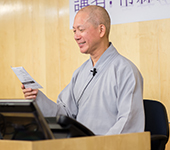
The Venerable Chang Lin, speaker of the “Mediation and Meditation” Seminar

"The difference between mediation and adjudication is in how to handle a ‘hard’ situation with a ‘soft’ approach – to calm the parties down." This is how the Venerable Chang Lin inspired participants in the "Mediation and Meditation" seminar held at the School in November.

Mediation, is a more peaceful and harmonious extrajudicial settlement of commercial or non-commercial disputes, that helps to reduce the cost of litigation and promote procedural economies in the conduct of proceedings as well as minimising the financial and psychological distress caused to parties involved.

Achieving a win-win situation through mediation

Following the Civil Justice Reforms in Hong Kong in 2009, and the passing of the "Mediation Ordinance" (Chapter 620) by the Legislative Council in June 2012 and its formal implementation in 1 January 2013, mediation has gained increasing public attention as an alternative tool for resolving disputes.

In recent years, the government has been promoting and developing mediation services to encourage parties involved to resolve disputes in lieu of expensive litigation. With the assistance of a trained mediator, the reasons for the dispute are identified, and an effort is made to develop solutions that are acceptable to both parties in order to reach a mutually satisfying settlement. This process not only saves both parties the time and money involved in civil proceedings, but more importantly, helps to achieve a win-win situation for both parties in a swifter, more effective and more harmonious manner.

 
Mediator adopts a neutral role

The mediation services in Hong Kong can in general be divided into two categories: integrated mediation and family mediation. Integrated mediation may cover such things as disputes over general commercial contracts, building renovation, banking, financial or insurance products, the acquisition of old buildings, medical disputes, etc. Family mediation, on the other hand, is focused on domestic and personal disputes such as separations or reaching mutually acceptable divorce settlements.

The mediator is jointly appointed by both parties to create a harmonious environment of dialogue in which to investigate the actual needs of both sides and reach an agreement. In the mediation processes, the role of the mediator is neutral. He or she is not there to determine who is right or wrong or to apportion blame, nor does he or she possess the power to make decisions for the parties in dispute.

 
How to become a mediator

To become a professional mediator, one needs to possess good interpersonal, communication and writing skills in addition to the relevant mediation skills training. Mediators often come into contact with people from different walks of life, so a wealth of social and life experiences can be a great asset. It is not a must for a mediator to possess either legal knowledge or a legal background, and the position is not necessarily filled by well-educated professionals.

 
Courses at the School meet the needs of society

In recent years, the Hong Kong Government has been a strong advocate of mediation services, and is keen to see the city become a regional centre for legal services and the resolution of disputes. Mediation will go hand in hand with the law, thus there is an increasing demand for professional mediators.

In view of this, the School has launched several programmes to train students to acquire basic and practical knowledge as well as mediation skills. In addition to the programme specially designed for mediators, there are programmes to help students handle disputes. Our Mediation Practice course has English and Chinese classes to suit the different language needs of our students.

The proportion of instructor to students in the Mediation Practice courses is 1:3. Through simulated dispute mediation cases, students will learn the skills to handle disputes in various ways. The courses are practical and can better equip students for their future needs as a mediator.

 
Related programmes
詳情 Basic Mediation Skills on Complaint Handling
詳情 Mediation Practice
詳情 調解實務
Copyright © 2014 HKU SPACE. All rights reserved.
Privacy Policy|Web Publishing Policy
Caring Organisation IMA with Best in Class IMA Top 10 Website of The Year