FAQs
FAQs  Login Success
Accounting & Finance FinTech and Financial Analytics
Certificate for Module (Macroeconomics, Global Finance and Data Analytics)
證書(單元 : 宏觀經濟學、環球金融與數據分析)

CEF Reimbursable Course

- Course Code
- FN161A
- Application Code
- 2465-FN161A
- QF Level
-
Financial assistance
Close QF Level panel
Continuing Education Fund
This course has been included in the list of reimbursable courses under the Continuing Education Fund.
- Credit
- 6
- Study mode
- Part-time
- Start Date
- 12 Jan 2027 (Tue)
- Next intake(s)
- May 2027
- Duration
- 30 hours
- Language
- English
- Course Fee
- Course Fee: HK$10,500 per programme (* course fees are subject to change without prior notice)
- Enquiries
-
2867 8331 / 2867 84242861 0278

Today and Upcoming Events
Accept new applications for Jan 2027 intake! There will be practical classes in the computer laboratory. Introduce the key concepts of macroeconomics, global finance and data analytics. Topics cover fiscal policies, monetary policies, and macroeconomic analysis. Illustrate the application of computational tools and software for data analytics. Discuss contemporary macroeconomics and global finance issues to assist informed economic and financial decision-making.
Programme Overview
Highlights

Programme Details
On completion of the programme, students should be able to
- examine key concepts in macroeconomics and data analytics;
- explain macroeconomics policies, global finance, international investment and trade;
- critically evaluate contemporary issues in macroeconomics and global finance; and
- apply computational tools and software to perform data analytics and economic analysis.
| Application Code | 2465-FN161A | Apply Online Now |
| Apply Online Now | ||
Days / Time
- Tue, Fri, 7:00pm - 10:00pm
- 30 hours per programme
- Hong Kong Island Learning Centre
- Kowloon West Campus
- Kowloon East Campus
Modules & Class Details
Modules
Course Content :
|
(1) Basic macroeconomics and data analytics
(2) Monetary and fiscal policies, and open economy macroeconomics
(3) Global finance, international investment and trade
(4) Contemporary issues of macroeconomics and global finance
Assessment method: In-class Exercise + Group Project Presentation
Award Upon successful completion of the programme, students who have passed the assessments with attendance no less than 70% will be awarded within the HKU system through HKU SPACE a "Certificate for Module (Macroeconomics, Global Finance and Data Analytics)". |
Class Details
Timetable
|
Lecture |
Date |
Time |
|
1 |
12 Jan 27 (Tue) |
19:00-22:00 |
|
2 |
15 Jan 27 (Fri) |
19:00-22:00 |
|
3 |
19 Jan 27 (Tue) |
19:00-22:00 |
|
4 |
22 Jan 27 (Fri) |
19:00-22:00 |
|
5 |
26 Jan 27 (Tue) |
19:00-22:00 |
|
6 |
29 Jan 27 (Fri) |
19:00-22:00 |
|
7 |
2 Feb 27 (Tue) |
19:00-22:00 |
|
8 |
16 Feb 27 (Tue) |
19:00-22:00 |
|
9 |
19 Feb 27 (Fri) |
19:00-22:00 |
|
10 |
23 Feb 27 (Tue) |
19:00-22:00 |
Remarks: Tentative timetable is subject to change, and course commencement is subject to sufficient enrollment numbers
Articulation Pathways
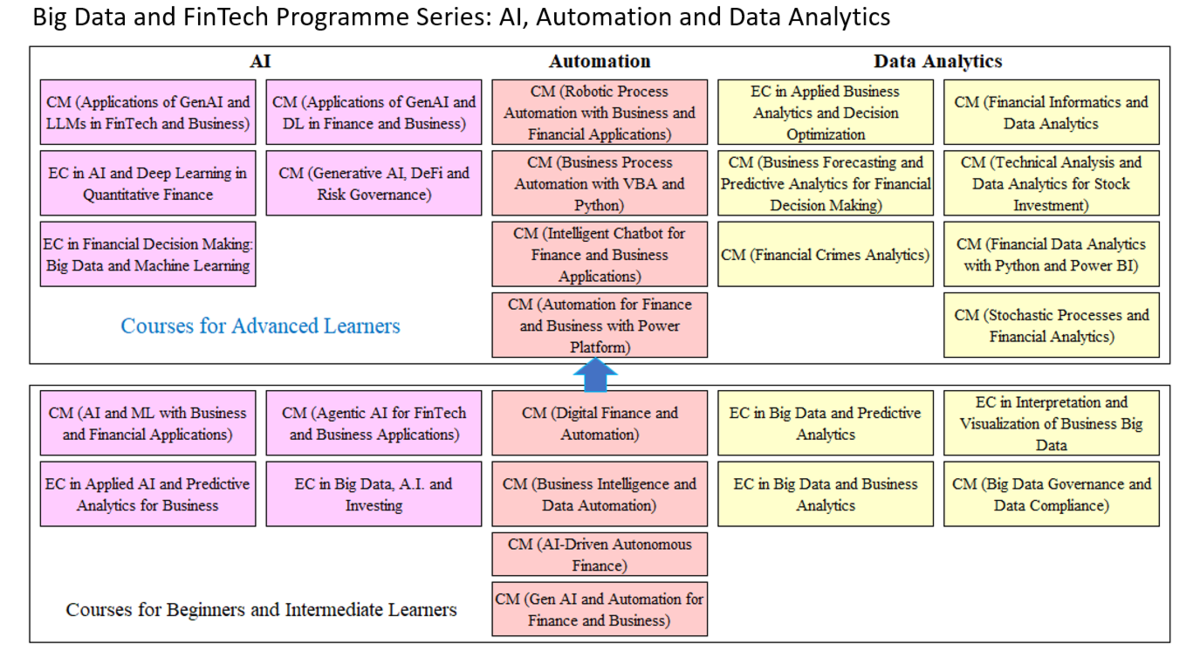
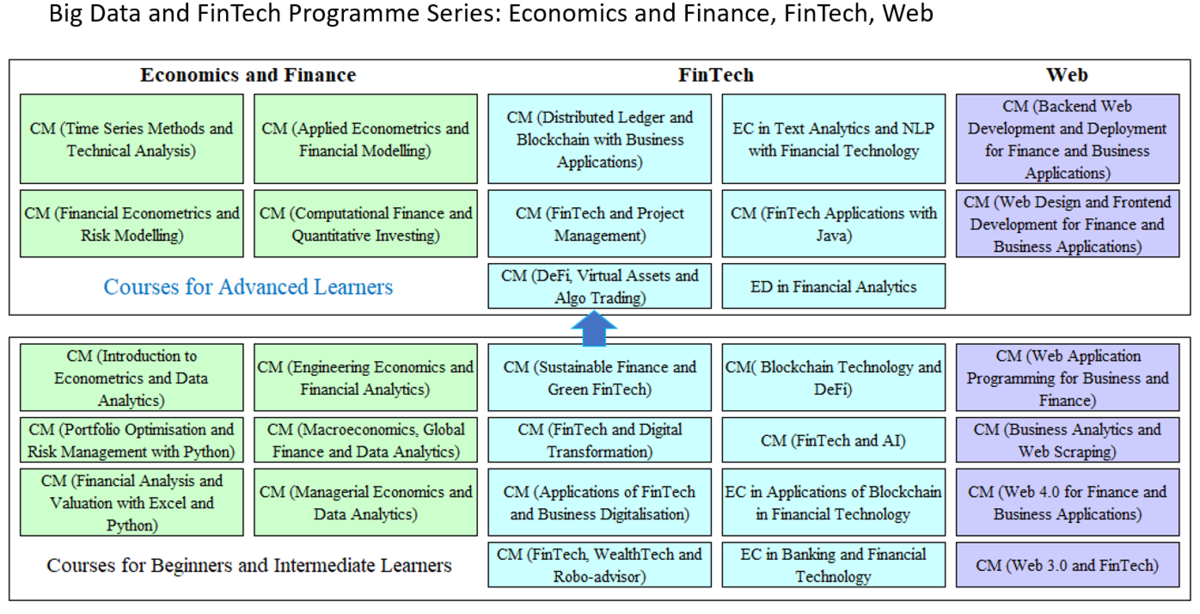
Progression Path
Teachers
Teacher Information
Mr Fred Cheng
Mr Fred Cheng is a seasoned Data Analyst with over a decade of experience in the financial sector. He has honed his expertise at top-tier multinational institutions, including Morgan Stanley, Julius Baer, and Singapore Exchange. With a strong foundation in data wrangling, analysis, report automation, dashboard development, and machine learning, he leverages data-driven strategies to enhance business decision-making and optimize performance.
Fred holds a Master’s degree in Business Analytics from the National University of Singapore and a Bachelor’s degree in Economics from the Chinese University of Hong Kong.
Mr Ken Choi
Mr Choi has over ten years of practical working experience across start-ups, data software companies, retail banking, insurance companies, listed companies, and large multinational corporation firms in areas of AI, business intelligence, big data and machine learning. He works as a senior project data analyst in charge of business process automation and data projects powered by AI, Machine Learning and Deep Learning. Moreover, he would like to leverage the Web 3.0 technology interaction with FinTech. Furthermore, he applies business analytics to predict the revenue growth of the corporation. He has been actively teaching and coaching in different institutes and schools over the decade. He is a professional in communicating abstract data concepts and theory to non-tech students efficiently and effectively. He holds a Bachelor (Hons) in Statistics and Operation Research from HKBU and a Master of Statistics and Risk Management from HKU. He is a certified FRM (Financial Risk Manager), Certified Statistical Business Analyst, Certified Predictive Modeler: Enterprise Miner, Certified Advanced Programmer, Certified Base Programmer, and Certified System Platform Administrator. All 5 Credentials were approved by SAS Institute.
Mr William Ma
Mr Ma is a practitioner in data-driven solutions for business operations and user analytics. He holds a Master of Science in Computer Science (Financial Computing Stream) with Distinction from the University of Hong Kong, specialising in algorithmic trading, financial analytics, deep learning, and big data management. He completed his Bachelor of Business Administration in Professional Accounting and Information Systems with First Class Honours from The Hong Kong University of Science and Technology. Before transitioning into the business analytics field, Mr. Ma served as a senior accountant at Ernst & Young and is a Certified Public Accountant (CPA) in Hong Kong.
Fee & Entry Requirements
Fee
HK$150
Course Fee- Course Fee: HK$10,500 per programme (* course fees are subject to change without prior notice)
Entry Requirements
Applicants should hold an Advanced Diploma, Higher Diploma or Associate Degree awarded by a recognised institution where the language of teaching and assessment is English. Those with a background in business, accounting, finance, economics, mathematics, statistics, science, engineering, IT or computer science would have an advantage.
Applicants with other equivalent qualifications will be considered on individual merit.
**Please upload copy of HKID and proof of degree while applying online.
CEF
- The CEF Institution Code of HKU SPACE is 100
| CEF Courses | ||
|---|---|---|
| Certificate for Module (Macroeconomics, Global Finance and Data Analytics) 證書(單元:宏觀經濟學、環球金融與數據分析) |
||
| COURSE CODE 33C166666 | FEES $10,500 | ENQUIRY 2867-8424 |
|
Continuing Education Fund This course has been included in the list of reimbursable courses under the Continuing Education Fund. |
Certificate for Module (Macroeconomics, Global Finance and Data Analytics)
|
Apply
Online Application Apply Now
Application Form Download Application Form
Enrolment MethodOnline Enrolment
HKU SPACE provides 24-hour online application and payment service for students to apply to selected award-bearing programmes and to enrol in most open admission courses (courses enrolled on a first come, first served basis) via the Internet. Applicants may settle the payment by using either "PPS by Internet" (not available via mobile phones), VISA or Mastercard online. Online WeChat Pay, Online AliPay and Faster Payment System (FPS) are also available for continuing enrolment in the same programme, if online service is offered.
For first time enrolment
-
Complete the online application form
Applicant may click the icon
 on the top right-hand corner of the programme/course webpage to make online application, and then follow the instructions to fill in the online application form.
Some programmes/courses may admit by selection, and may require applicants to provide electronic copy of any required documents (e.g. proof of qualification) as indicated on the programme/course webpage. Only file format in doc, docx, jpg and pdf are supported. -
Make Online Payment
Pay the application or programme/course fees by either using:
"PPS by Internet" - You will need a PPS account and a PPS Internet password. For information on how to open a PPS account and how to set up a PPS Internet password, please visit http://www.ppshk.com.
*Credit Card Online Payment - Course fees can be paid by VISA or Mastercard including the “HKU SPACE Mastercard”.
* HKU SPACE Mastercard cardholders who wish to enjoy 10-month interest free instalment scheme must pay their tuition fees in person at any of our HKU SPACE Enrolment Centres.
To know more about first-time online application/enrolment and payment, please refer to the user guide of Online Application / Enrolment and Payment:
For continuing enrolment in the same programme
Selected programmes offer online continuing enrolment service. Programme staff will inform students if they offer this service and offer further enrolment details.
Online Payment can be made via "PPS by Internet" (not available via mobile phones), VISA or Mastercard, Online WeChat Pay, Online AliPay and Faster Payment System (FPS)
In Person / Mail
For first time enrolment
-
For first come, first served short courses, complete the Application for Enrolment Form SF26 and bring or post the completed form(s), together with the appropriate application/course fee(s) and any required supporting documents to any of the HKU SPACE enrolment centres.
[Download Enrolment Form SF26] -
Award-bearing and professional courses may require other information. Forms are usually available at the enrolment centres or on request from programme staff. Bring or post the completed form(s), together with the appropriate application/course fee(s) and any required supporting documents to any of the HKU SPACE enrolment centres.
For continuing enrolment in the same programme
-
The standard ‘Enrolment/Payment Slip’ is designed for students of award-bearing programmes or remaining programmes in a suite of programmes requiring continuing enrolment and it applies to most programmes.
-
Students should complete the “Enrolment/Payment Slip” which will be made available by relevant programme staff and return the slip to any HKU SPACE enrolment centre or post it to the relevant programme staff with appropriate fee payment.
Please refer to available Payment Methods for fee payment information. If you are in doubt about the procedures, please check the individual course details, or contact our programme staff or enrolment centres.
Please note the followings for programme/course enrollment:
- To make an application online, you will need a computer with connection to the Internet and a web browser with JavaScript enabled. Google Chrome is recommended.
- Applicants should not leave the online application idle for more than 10 minutes. Otherwise, applicants must restart the application process.
- Only Early Bird Discount is supported for Online Applicants (Application). To enjoy other types of discount, please visit one of our enrolment centres.
- During the online application process, asynchronous application and payment submission may occur. Successful payment may not guarantee successful application. In case of unsuccessful submission, our programme staff will contact you shortly.
- Applicants are reminded that they should only apply for the same programme/course once through counter or online application.
- For online enrolment, a payment confirmation page would be displayed after payment has been made successfully. In addition, a confirmation email would also be sent to your email account. You are advised to keep your payment confirmation for future enquiries.
- Fees paid are not refundable except as statutorily provided or under very exceptional circumstances (e.g. course cancellation due to insufficient enrolment).
- If admission is by selection, the official receipt is not a guarantee that your application has been accepted. We will inform you of the result as soon as possible after the closing date for application. Unsuccessful applicants will be given a refund of programme/course fee if already paid.
Disclaimer
The School provides a platform for online services for a selected range of products it offers. While every effort is made to ensure timeliness and accuracy of information contained in this website, such information and materials are provided "as is" without express or implied warranty of any kind. In particular, no warranty or assurance regarding non-infringement, security, accuracy, fitness for a purpose or freedom from computer viruses is given in connection with such information and materials.
The School (and its respective employees and subsidiaries) is not liable for any loss or damage in connection with any online payments made by you by reason of (i) any failure, delay, interruption, suspension or restriction of the transmission of any information or message from any payment gateways of the relevant banks and/or third party merchants for processing credit/debit/smart card or other payment facilitation mechanism; (ii) any negligence, mistake, error in or omission from any information or message transmitted from the said payment gateways; (iii) any breakdown, malfunction or failure of those gateways in effecting online payment service or (iv) anything arisen out of or in connection with the said payment gateways, including but not limited to unauthorised access to or alternation of the transmission of data or any unlawful act not permitted by the law.
1. Cash, EPS, WeChat Pay Or Alipay
Course fees can be paid by cash, EPS, WeChat Pay or Alipay at any HKU SPACE Enrolment Centres.
2. Cheque Or Bank draft
Course fees can also be paid by crossed cheque or bank draft made payable to “HKU SPACE”. Please specify the programme title(s) for application and applicant’s name. You may either:
- bring the completed form(s), together with the appropriate course or application fees in the form of a cheque, and any required supporting documents to any of the HKU SPACE enrolment centres;
- or mail the above documents to any of the HKU SPACE Enrolment Centres, specifying “Course Application” on the envelope. HKU SPACE will not be responsible for any loss of personal information and payment sent by mail.
3. VISA/Mastercard
Applicants may also pay the course fee by VISA or Mastercard, including the “HKU SPACE Mastercard”, at any HKU SPACE enrolment centres. Holders of the HKU SPACE Mastercard can enjoy a 10-month interest-free instalment period for courses with a tuition fee worth a minimum of HK$2,000; however, the course applicant must also be the cardholder himself/herself. For enquiries, please contact our staff at any enrolment centres.
4. Online Payment
Online application / enrolment is offered for most open admission courses (enrolled on first come, first served basis) and selected award-bearing programmes. Application fees and course fees of these programmes/courses can be settled by using "PPS by Internet" (not available via mobile phones), VISA or Mastercard. In addition to the aforesaid online payment channels, new and continuing students of award-bearing programmes with available online service, they may also pay their course fees by Online WeChat Pay, Online Alipay or Faster Payment System (FPS). Please refer to Enrolment Methods - Online Enrolment for details.
Notes
-
If the programme/course is starting within five working days, application by post is not recommended to avoid any delays. Applicants are advised to enrol in person at HKU SPACE Enrolment Centres and avoid making cheque payment under this circumstance.
-
Fees paid are not refundable except under very exceptional circumstances (e.g. course cancellation due to insufficient enrolment), subject to the School’s discretion. In exceptional cases where a refund is approved, fees paid by cash, EPS, WeChat Pay, Alipay, cheque, FPS or PPS by Internet will be reimbursed by a cheque, and fees paid by credit card will be reimbursed to the credit card account used for payment.
- In addition to the published fees, there may be additional costs associated with individual programmes. Please refer to the relevant course brochures or direct any enquiries to the relevant programme team for details.
- Fees and places on courses cannot be transferrable from one applicant to another. Once accepted onto a course, the student may not change to another course without approval from HKU SPACE. A processing fee of HK$120 will be levied on each approved transfer.
- HKU SPACE will not be responsible for any loss of payment, receipt, or personal information sent by mail.
- For payment certification, please submit a completed form, a sufficiently stamped and self-addressed envelope, and a crossed cheque for HK$30 per copy made payable to “HKU SPACE” to any of our enrolment centres.
- More Programmes of
- FinTech and Financial Analytics Economics